23/10/26
Basket
23/10/26
Baulking Lake & Fish Farming
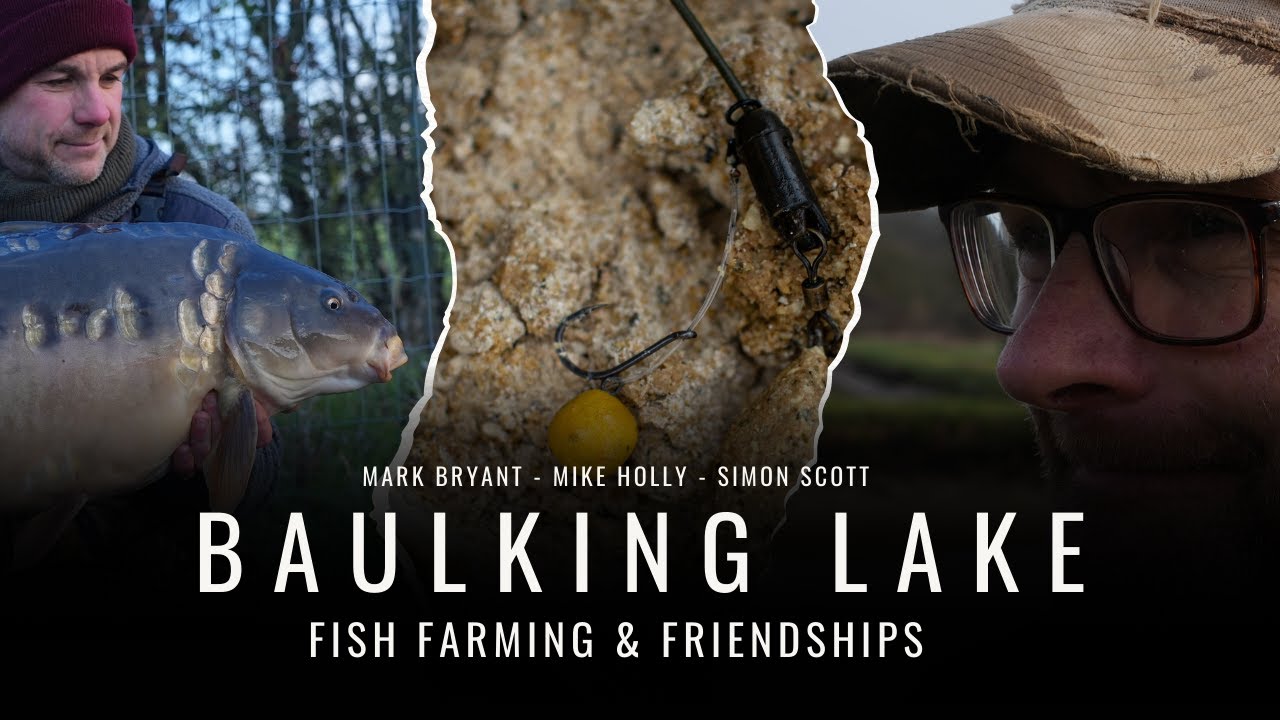
In this diary, Baitworks’ Mike Holly and Mark Bryant head to VS Fisheries to help net and hand-pick carp for a Cotswold fishery, before a freezing winter carp fishing social at Embryo’s Baulking Lake. An honest look at fish farming, stocking, and catching in sub-zero conditions. Full transcript below.
Chapter 1: Preparing for fish farming
Mike: No way has that got on the end of your nose through work. What is it, dirt?
Mark: It’s a perfectly placed blob of mud, strategically placed on the end of your nose to make it look like you’ve been working hard. It’s always good to have a little fleck like that, because when the Mrs sees it, I can say, “Oh yeah, I work down the farm. Busy day.”
Mike: Put a bit more on, smear it, match it up on the other cheek. Looks like war paint. There you go, Claire, look, working hard. She’ll never watch this, will she?
Mark: I’ll play it back to her. Look how hard we’ve been working.
Chapter 2: Arriving at VS Fisheries
The year had once again gone by in a blur, maybe that’s an age thing, but time seems to go twice as fast these days. As winter arrived, that always means a trip to VS Fisheries to help Simon and the gang. Fish farming is seriously hard graft, but over the next few days we’d be netting hundreds of carp, and some of these would be coming back with us in the van to the Cotswolds, to their new home. Choosing them, however, is never an easy task.
Mike: Little leathery one. This is quite ironic. I left the office this morning having just finished the payroll for the Baitworks staff, and now this is my office, Scotty’s fish farming truck. I’ve replaced a lovely warm desk. The struggle is finding a space where there’s no mud. Cameras, mud and all things tech do not like the life of a fish farmer. Look at the back of that, it looks like a skip. I don’t envy those boys, it’s hard graft.
Chapter 3: Analysing the growing pond
Simon: In terms of a growing pond, as a fishery this would be quite boring, no trees around it, but it’s a great growing pond. It runs north-south, so it gets sunlight all day, not shaded by marginal trees, very little leaf litter. It’s a very good production pond, it grows fish very well. In summer it warms up quickly, and when we get any southerly or south-westerly, you get a great chop on it. It can look like Brighton beach, crashing down the other end, so it turns the whole pond over. Wind and sunlight are really important.
Mike: That’s key, is it?
Simon: It makes a big difference. If this lake was completely surrounded by trees it would look lovely as a fishery, but as a growing pond it wouldn’t be as good.
Chapter 4: Challenges in selecting fish
Simon: We’re netting from the shallow end down, towards the pump at the deep end. We don’t normally use the pump on this one, but we’ve had a wet week, so we ran it for a few hours to get the water level down and enable us to catch the fish. Have you seen anything that tickles your fancy?
Mike: I’ve seen loads, that’s the problem, you want to take them all. So many nice fish, proportionally perfect, and because of all the different strains down here, lots of crosses, you see all shapes and sizes. Are you going scaly or non-scaly? I’m going to mix it up, anything that looks proportionally right, scales or no scales. I’ll be picking tomorrow, when we go to the ones being sold. The challenge is trying to pick out 10, 15, whatever it is. Last time it took us a day to choose 10 carp. But it’s not trivial, it’s an investment into fish that are going to be in your fishery for 40 years. These fish could outlive me, I’m nearly 50. For most fishery managers, this is a big deal.
Chapter 5: Completing the harvest
It had been a long day, but every single carp in those ponds had been netted, accounted for, and popped into holding tanks ready for customer deliveries. We put the beds up in the fish house, had a shower, and planned to head out for a curry. Tomorrow was a big day, we had to choose which ones came home with us.
Chapter 6: The wager on a future monster
Mike: Simon’s only given me the socks he caught the Burghfield Common in. These are his spare pair of socks that he caught the Burghfield Common in. Better get your rods out. That’s a flex. You can verify it if you want, Simon.
Simon: Yes, they are. [laughs]
Mike: The jury’s out, no verification there. If it’s a big one, I’ll be having them. So, this is happening. Tomorrow Will’s going to pick out a fish for me to take back to the Cotswolds, and we’re going to call it Will’s Choice. We’ll be tracking it, and if it ever gets to 50 pound, there’s going to be free bait for the year and a free ticket for the lakes. All he has to do is pick one and hope for the best, using his expertise of many years of fish farming. Will handles carp every single day, so this is big pressure.
Mark: Already got one picked out?
Will: Already picked one out.
Mike: They’ve only been in the holding tank a few hours and it’s dark, this is key. What are you looking for, Will? How has that single carp got your attention? Big frame already, looks like a 50, just a miniature. And I noticed, when he spots a big one, he strokes his beard. When the beard gets stroked, that’s the one to look at. We’ll check back in the morning. It’s all on Will. No pressure.
Chapter 7: Selecting the new stock
Simon: Right, Mark, what are you looking for?
Mark: It’s really difficult. A lot of customers come and say, “Can you pick me a big one?” But in my experience, what makes a really cool carp fishery is one where they all look different. You want everything from deep high-backed fish to long fish, scaly fish, plain fish, commons, zip linears, leathers. The more variety, the more interesting the fishery. Those are the places I’ve enjoyed most, you never know what the next one’s going to look like.
Simon: We’ve certainly got a variety here. If you see a fish you like, we’ll pop it in the blue bin, make a selection, then narrow it down.
Mark: I like the shape of that one, lovely male one. He’s a proper chunky one, big thick wrist, got some potential. Let’s put that in the pot.
At last, we’d picked our carp, a real variety of shapes and scale patterns, all with excellent genetics. Planning for the future with new fish is always incredibly satisfying.
Chapter 8: Loading the carp
All that was left was to weigh them, pay for them, and let Will pick his future monster.
Mike: Is this the one, Will?
Will: This is definitely the one.
Mike: Wow, look at that. Great shape.
Will: It’s one of the bluey-grey ones. Big shoulders, high back, big frame, look at the wrist on it.
Mark: That’s got 50 pound written all over it.
Mike: We’ll track this fish and we’ll see. We’ll call it Will’s Choice. What a selection, the last three to go in the bags, all different. Big scales, zip linear, grey, high shoulders. They’re going to fit right in in the Cotswolds. As my journey ends today, these guys are starting theirs. Good luck, mate, hopefully you’ll be around a very long time.
Chapter 9: Arrival at Baulking Lake
Mike: Are we mad or not? It’s minus two. Look at the windscreen, frozen solid. But one thing I do know is I’m not going to catch sat at home. Let’s give it a go.
Next in the diary was a winter social with Mark over at Embryo’s Baulking Lake, between Swindon and Oxford. The only downside is Mark doesn’t work well in the cold these days, and when we arrived it read minus 5 on the gauge. We didn’t know much about the venue, but we knew it had loads of lovely carp, including plenty of VS carp. Embryo had put a tremendous amount of time and investment into this fishery, and we couldn’t wait to give it a go.
Chapter 10: Assessing the frozen lake
Mike: Morning, mate. Is this what the winterised Mark Bryant looks like?
Mark: It’s certainly not a good morning, it’s a bloody freezing morning. So cold.
Mike: We always pick these times to come fishing. Remember Orchid Lakes, the margins were frozen, and you forgot your winter sleeping bag?
Mark: It was horrendous. Lasted one night. But I fluked a couple out.
Mike: You’ve come dressed for the Antarctic.
Mark: Got my moon boots and my old Skee-Tex in the van, with new liners. Winning. Come on, let’s look at what we’re up against.
Chapter 11: Coffee break and planning
Despite the freezing conditions, the lake looked incredible. Not a breath of wind, so perfect spotting conditions. We walked round to swims one and two and, much to our surprise, started seeing them show around 40 to 50 yards out. So it was back to the van for a coffee before making a plan.
Mike: I’ve got the kettle on, but look, Mark, we’ve got a little gift to try.
Mark: Now I’m in the coffee club, I can try some?
Mike: It’s only taken you 47 years. The artwork is fantastic. I wouldn’t give up your day job, Tom, but I’m loving the inspirational message.
Mark: He’s got the right-side sling on it, but the head should be the other side. I prefer holding them in the other hand.
Mike: It’s all about the minor details. Tom Wilshaw of YouTube fame makes incredible fishing content and has a coffee company, and for a man obsessed with coffee like me, Christmas has come early. Let’s start the day with a Tom Wilshaw coffee in hand. Thank you, Tom.
Chapter 12: Setting up camp
Mark’s like an old car in the winter, he has to pull out his choke and give himself time to warm up. But having looked at the weather, it was about to warm up considerably, with nighttime temperatures nearly into double figures. Had we got the timing just right?
Mike: This looks like the obvious point, one, two, and they’re showing in this area.
Mark: There’s frost on my fingers still. If you look at the scale, what depth is that? Anything from 15 to 18, which with the average depth so deep is a good area, a good depth. The sun hits that bank first, so that’ll benefit us, but also the carp. Given the choice, that’s where I’d be as an angler and as a carp.
Mike: Let’s get around and get some rods out, fuelled by coffee. Thanks, Tom.
Chapter 13: Developing a stealth strategy
Mike: The bivvy’s up and it’s bitterly cold. I’ll get my excuses in early, because usually on these trips we have a friendly spoof for first choice of swim. The fish were showing in front of a swim next door. This time we didn’t spoof, no “who’s got the longest stick”. I just said, “Mark, you have that swim and I’ll go one down to his right.” It looks a bit like no-carp corner compared to the dolly hole that Mark’s in. I made sure he has all the odds stacked in his favour, because it’s winter, and if we blank, I’ve got a good excuse: he got first choice of swim.
Chapter 14: Baiting in cold water
The plan was to get fishing as quietly as possible. We felt for drops and sat back for a few hours to see if we could nick a quick bite.
Mike: For the moment, I’ve dotted about 15 to 20 12mm CreAmino all around the area, enough for a bite. Going into the evening, I’d like to get a bit of bait out, so I’ll set up my marker rod with a light lead on braid, have two or three casts to feel what’s on the bottom. Rather than finding spots within spots, it’s just baiting an area. When those fish migrate in, hopefully in the morning, there’s bait dotted around. That baiting situation is far less spooky for these pressured fish than putting the Spomb out in a localised pile. I’ve got a tiny little Gardner spod, the little yellow one, if you lay it down gently it hardly makes a sound. I’ve got some crushed CreAmino and a tiny bit of hemp. I’ll put the 12mm CreAmino out in the stick, scatter an area, and maybe four or five little spombs with a bit of hemp to hold some fish.
Mike: Josh, who looks after the water, gave us a nod and said if you can, don’t use the Spomb, they’re pretty spooky of the noise. It’s always a conundrum, because what’s the opening gambit of most anglers? Get the leading rod out, get the Spomb out. Those fish were here this morning. If we’d done that, I think we’d have pushed them out. These fish want to be here, so we want to bait accordingly. We’ve both had minimal casts. We’ve got a night or two, so we’ll see what happens.
We headed into our first night of Baulking quietly confident, having got a little spread of bait out as quietly as we could. But with 14 hours of darkness ahead, it was time to cook a meal fit for a king.
Mike: There’s a steak under there with garlic mushrooms, sweet potato chips and some toms, and Mark’s got the same.
I was up at 6am after eight hours in the bag, desperate to stretch my legs, plus coffee was calling.
Mike: Mark’s skipped his rods in and gone round the other side for a look, off the back of the wind, where he thought he’d seen a couple. It was bitterly cold, minus 5 yesterday morning, but last night the conditions changed drastically, a big drop in pressure, more favourable for a bite. Unfortunately we’ve had nothing. So there’s a move possibly on the cards, but — oh, that’s a take.
Chapter 15: Early morning action
Mike: Gone from zero to absolute hero. Got two, mate, that’s mental. Sod’s law, I was just doing a bit to camera, I had one take while recording, and then the other rod was ripping off as I was netting the first. Double trouble. There’s the bait still floating in the net, half a little Hauler there. That one looks about 15 pound, this one maybe 20 pound, a mirror. What a result. It caught me by surprise, we’d seen no shows here all morning.
Mark: Sod’s law, isn’t it, when you need a cameraman you’re off on your toes. I saw one fish right at the top end.
Mike: That’s a freezing cold Baulking Lake carp, not the biggest, probably one of the smallest fish in Baulking, but we can’t be fussy. It’s nearly December and yesterday it was minus 5, so any bite is very welcome. And I’ve got another one, slightly bigger, a freezing cold common. My hands are cold, but that’s the occupational hazard of winter carp fishing. Definitely put a smile on my face.
Chapter 16: Adjusting tactics for bites
Winter bite times are often small windows, so we quickly got the rods back out.
Mike: I’m using a stick mix made of some EDGE pellets, about half a kilo of the Pro Flow minced into crumb, some krill powder, some C-Stim, and some green-lipped mussel, compressed into a little stick and slid down the hook link.
Meanwhile, Mark stuck with his super-attractive paste-wrapped chods with little 12mm Hauler pop-ups. That little bit of attraction is just enough to bring the fish down, and hopefully you see the yellow pop-up and bang. Breakfast was calling, but best-laid plans went out the window as a group of fish moved onto Mark.
Mark: I put the rod back out, five minutes, and it’s gone off. That’ll do. I thought I was going to have to move, and suddenly it’s gone within 20 minutes.
Chapter 17: Increased activity and baiting
Mark: Here’s my first Baulking carp, very welcome after a freezing day and a windy night. They’ve turned up, Mike’s had a couple, so I might as well slip off with this one.
As soon as Mark got the rod out, it was away again. He had two at the same time, taking our tally to five bites between us. Ryan and Matt came down for a natter and helped out with the chaos. The wind was howling into our faces, but it was a warm wind, and the carp were happy to stay put.
Mark: Ryan was right, 28lb 11oz, my second Baulking carp, in quick succession. This one was on contrasting tactics to Mike’s little sticks. I’ve gone with chod rigs, small 12-millers, little CreAminos and Haulers, and I’ve put a few spombs out, well, an old-school spod I’ve had for years. A few handfuls of hemp and a few boilies, just to try and hold a few fish. Best get the rods back out. You’ve made me very happy on a cold, blustery day.
Chapter 18: Final evening preparations
Mike: He’s back. That’s bait, lots of it. Never did I think, being brutally honest, that in December we’d be going back to the van for more bait.
Mark: Me neither. But these conditions have transformed from yesterday. You can feel the pressure drop, a warmer wind, no frost, and it’s spurred them on.
Mike: Luckily we brought this. The only downside is, we’ve been pretty stealth up to this point, and I hate to use it, but with this wind I can’t use the throwing stick anymore, can’t get the baits where I need them. So it’s going to have to be a little Spomb, which goes against everything I wanted to do.
Mark: Your little Gardner one, mate, is as stealth as it can be. My little bullet.
Mike: How long have you had that?
Mark: 30 years, mate. Last time I used it was at Horseshoe 30 years ago.
Once again it was dark before 5pm, but with all traps set, we devoured a well-earned dinner and discussed some late-night fish-spotting tactics.
Chapter 19: Last night fishing
Mike: As a suggestion, we set our alarm for two-hour intervals and you stand on the jetty, listen out for carp for two hours, and then I’ll do a two-hour rota. That’s what the big-carp anglers were doing.
Mark: Maybe. Listening for the shows at night.
Mike: You take the first shift. New cool thing is kip and rip. If that goes, all well and good. If not, I’ll have a good night’s sleep.
The gentle roar of the Coleman replaced my usual 6am alarm, and the morning feeding spell was right on cue. As I bundled a plump mirror into the net, I heard one of Mark’s alarms signal a stuttery take.
Chapter 20: Wrapping up the winter trip
Mark: Good morning. What a way to start the morning. I’ve got one in the net already, a bit of a repeat of yesterday, gone off straight away. I’ve only got an hour or so before I’m on the road, so this is a great end to a successful couple of winter days.
Mike: Here’s the other one, a lovely way to end a cracking couple of days. You were in the dolly hole.
Mark: I think I was, yeah.
Mike: You went straight in there like a rat up a drainpipe. We’ve had a flurry of fish, a great time, really enjoyed it. But as ever, it’s always time to go, it’s never enough. I’ll get this one back to his other 600 mates out there.
Mark: What are you looking forward to most at home? A bath. A nice warm bath would be the one. It’s been fun. Thanks, mate.
Mike: That’s a wrap. Winter specialist.
Mark: Hero status. See you later, mate.