01/03/21
Basket
01/03/21
***Catch More Carp*** Mark Bryants – Spring Tips & Tactics
Catch More Carp – Spring Tips & Tactics
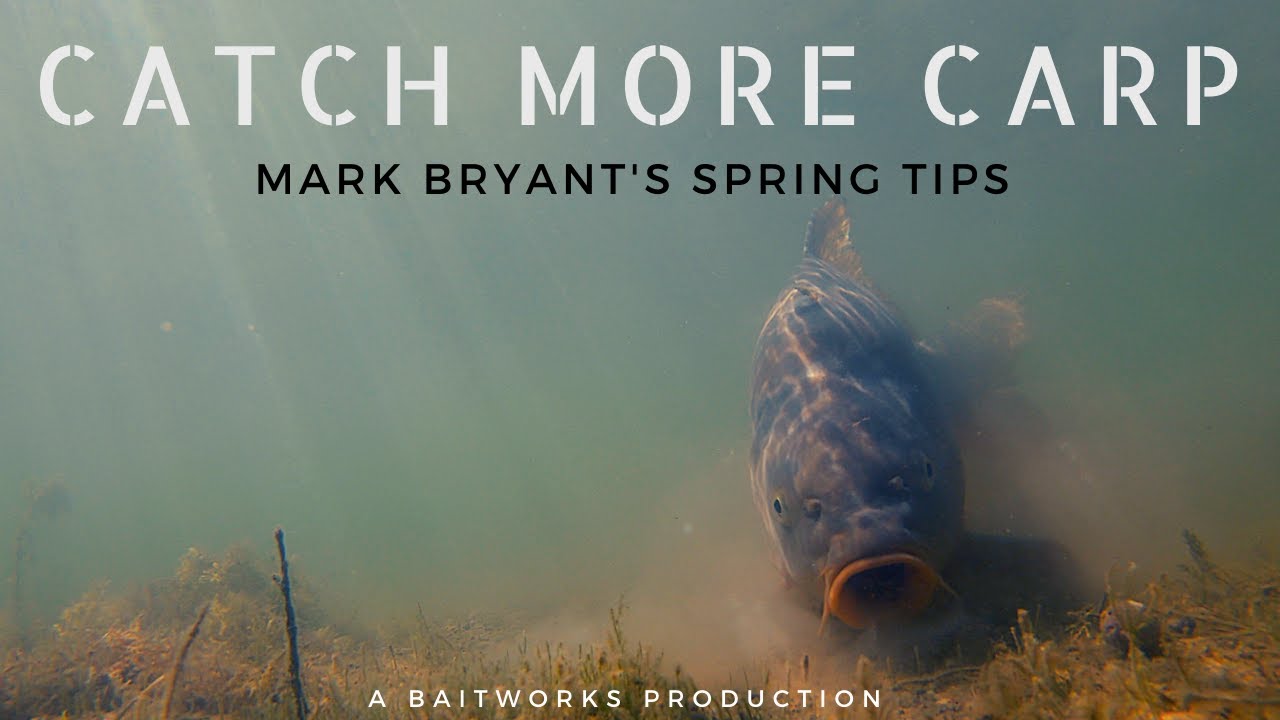
Baitworks’ Mark Bryant shares his top tips for spring carp fishing, drawing on years of experience to explain how changing water temperatures, sunlight and wind affect carp behaviour. From finding warmer areas of the lake to choosing the right tactics and baiting approach, Mark offers practical advice to help you put more carp on the bank this spring. Full transcript below.
Chapter 1: Introduction
Well, with spring just round the corner, I thought it’d be a great opportunity just to go back over a few observations I’ve had over the years about actually what the carp are doing at this time of year.
And that’s integral for putting into your own fishing, because that can dictate how you fish and where you fish for these carp that are literally just waking up.
So I’m going to go back over a few little tips, and I’m sure this will put a few more spring carp on the bank for you.
Chapter 2: Understanding Carp Behaviour
Well, fundamentally, before we get into the approach, location, etc., I think it’s really important to bring it back to the actual quarry itself, and of course that’s the carp, and to understand what’s happening to them in this cold-water environment just coming into the spring.
Now, it’s been freezing cold over the last few weeks, down to minus six or something stupid like that a couple of weeks ago, and a lot of these lakes were frozen.
Coupled with the fact that the angling pressure is very, very low due to lockdown, and only the odd people are fishing, a lot of fish have gone to ground almost.
And it’s no surprise that the odd fish that were caught have come out with loads and loads of parasites on them, in the shape of leeches and Argulus, which tells you that the fish have been sitting very close to the bottom or in weed beds where the parasites live and can attach very, very easily.
So that’s worth considering.
Now, these fish are slowly coming out of that state because the light levels are increasing.
And that’s really, really important to understand, that as the daylight hours increase, there’s more heat getting onto the water.
And the carp know, through obviously years and years going back hundreds of years, they know their body clock is starting to wake up. And they understand that and perceive the light levels as that ticking clock, and everything’s gearing towards spawning at this time of year.
Although it seems a little way away, we’re, you know, we could be only sort of, I don’t know, eight weeks away from that at this period. And the fish could spawn quite early if they get the temperature.
Everything is gearing towards that massive event in their life.
And two things on the carp’s mind at the moment, particularly, is to get warm, get warm as quickly as they can, and obviously then food is high on the agenda as well.
Now, they need to get warm. One is to obviously get their metabolism back up so they can be sharper, so they feel less vulnerable as well to predators.
If you imagine these fish obviously are waking up from the winter, they’re still very, very clumsy.
And at this time of year, you can get away with very bright hookbaits and high pop-ups and all that, because everything’s a little bit suppressed metabolism-wise.
So their number one aim is to get warmer.
Chapter 3: Locating Spring Carp
And there’s key areas where you can look on the lake which will tell you where you’d expect them to turn up.
One of them is snags, particularly if you get some sun-facing snags, facing the sun, I should say. That is an absolute goldmine.
There’s a bit of safety there, but they’re getting warm, and finding these fish, or finding those areas that get warm quickly, is a key.
But that brings us nicely onto a bit of location.
Well, one thing at this time of year, or two things at this time of year, is the wind and the sun.
They play a huge, huge part, I’ve found, in the spring.
In all the years I can think, when that sun comes out and there’s a wind pushing, regardless of the direction, then generally that wind combined with the sun is going to be warmer than the actual water temperature itself.
And wherever those warm layers are pushing to, that is the place to look, in my experience.
You know, that warm water is such a big draw for those carp, and you often find them up in the upper layers, capitalising on that.
And that’s why there’s no doubt why zigs are so effective this time of year.
The fish want to be up in that warm layer to get warm, and of course that’s where it is, especially when you get a bit of a chop on the water as well with a bit of sun. That’s golden.
But one thing I’ve found in the spring is obviously the shallow water plays a massive, massive part as well.
Chapter 4: Shallow Water and Food
Now, if you can find shallow water that has the sun beating on it every day, that is a win-win.
And generally, you know, the side getting a lot of sun would be a north sort of facing bank.
And it was no coincidence last year, if we were walking around the lakes about this time of year, I noticed that the carp were getting up and down this bank, and they were getting really tight to the bank.
When I say tight, the lake was actually flooded from all the water we had had, and the fish were actually feeding in areas where there would have been people fishing last year.
That’s how tight to the bank they were, up in literally three and a half foot of water.
And if they could have gone further, I’m sure they would have, but there were some trees in the way.
But the important thing was they were in there taking advantage of the warm water.
But another thing that takes advantage of the warm water at this time of year is all your naturals as well.
So all your shrimps and your snails, any nymphs, are all migrating to the shallowest point in the water to capitalise, like the fish are, on the sun.
And then you’ve got a situation where the naturals are migrating to the shallower water, the fish are there because of the warmth, and suddenly they’ve got food.
And it was, you know, I found lots of carp along the bank last year, managed to catch one as well.
But observation, and going out with my little net and just sweeping through the margin, showed me what they were feeding on, and it was just loads and loads of shrimp.
So really, really important to keep that sort of front of mind, and I’ve always found in the spring sun and wind play a massive role in where I’m going to look.
Thank you very much, fella. I’m going to get you back.
Yeah, I can’t wait to get back down again.
Chapter 5: Spring Fishing Approaches
Well, moving on to the approach, I think now we’ve sort of hopefully understood where potentially we could find, where we’d like to find some carp.
I think the approach is really important to try and get right up at the start, particularly early March, because the water temperature is still very, very cold.
And I’ve found you can sometimes blow your chances by putting in too much bait.
And for me, looking at, listening to a lot of sort of catch reports and talking to a lot of customers, it’s no coincidence that little pockets of bait, almost like little traps, this time of year really, really come into their own.
So, like a PVA bag with lots of attraction in a small, localised little area. Absolutely deadly.
And also high chod rigs or high pop-ups, particularly when you’re putting them over dying weed, so you get that nice contrast of colour from dark, decaying weed with a bright hookbait that stands out like a sore thumb on the bottom and is worthy of investigation from the carp.
But, you know, what you’ve got to consider as well, if your lake hasn’t got that shallow water that we talked about, zigs at this time of year come into their own.
You know, no other time coming into that spring period where that warm water’s just starting to warm the upper layers.
Those fish spend a massive amount of time in that area anyway, and they can drift into the shallow areas at that level.
But when they’re out in the middle of the ponds, then nine times out of ten those zigs can be absolutely deadly.
So ignore those at your peril.
But like all of this, you know, there’s no hard and fast rules of carp fishing. That’s what makes it so interesting.
It does come down to stock density, it does come down to how many fish are in the water, size of water, weed, exactly.
There’s loads and loads of things to add to the puzzle as well.
But those approaches, I think, this time of year will stand you in good stead.
And as we move through the gears and move through the weeks leading into March and April, that’s the time when we can, once we find the fish, start applying a little more bait and fish more in a more conventional way.
Chapter 6: Summary and Final Tips
Well, to summarise, I think, you know, it’s very important to bring this all back to the carp.
Understand what they’re doing, how they’re affected by temperature, wind and the sun, and from that you can then start to plan your approach and hopefully find a few fish or two.
And this leads us nicely on to where I am today.
I’ve come down for a few hours fishing in the day. I’ve started off now on one of the banks which did get a bit of sun this morning and a bit of wind.
But if there’s one tip I can give you, and a takeaway from this, it’s to follow that sun where it’s tracking around, because it will hit different parts of the lake at different times of the day.
And it’s no coincidence that a couple of days ago the sun was out in the afternoon, and I know that it’s going to hit one of the shallow bays come sort of two o’clock.
And that’s where I’m going to be.
So I’m going to pack down in a minute and get there and get a couple of baits out.
And fingers crossed all this information will put a few fish on the bank for you.