20/10/21
Basket
20/10/21
Elliott Grays – Mega Boosted Hookbaits
Elliott Gray reveals his mega-boosted hookbait recipe: how he layers Scent from Hell, Crustacean and C-Stim onto Atlantic Heat wafters for faster bites. Watch now →
Suggested on-page intro: Baitworks consultant Elliott Gray shares the step-by-step process he uses to turn standard wafters into heavily boosted hookbaits that stand out on a baited spot. He covers hookbait colour, matching your feed, and the week-long curing process with Scent from Hell, Crustacean powder, C-Stim and hot fish oil. Full transcript below.
Why hookbaits are crucial
Hookbaits, to me, are a crucial part of catching carp, particularly at this time of year. We’re at the end of spring now, coming into summer, and from this period onwards, right through to winter, I’ll use a lot of bait. Once these fish have spawned they’re hungry, looking for food, and I want to give them plenty.
The one downside to putting a lot of bait in is that it can make it quite hard to get a bite. If you put five, six, seven kilos out, particularly with particles, a fish can come onto the spot and spend a long time feeding before it gets to your hookbait and you get a bite. By having a hookbait that matches everything on the spot, you could get a bite very quickly, but equally it could be one of the last items picked up. So I want a hookbait the carp are drawn towards.
Colour: a subtle tip
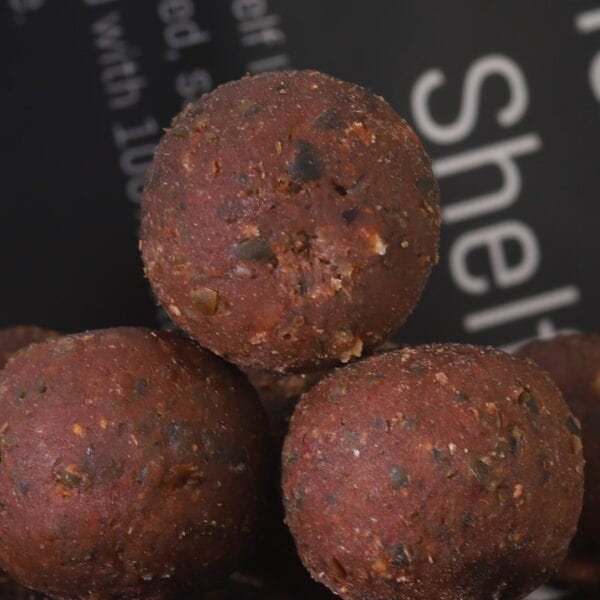
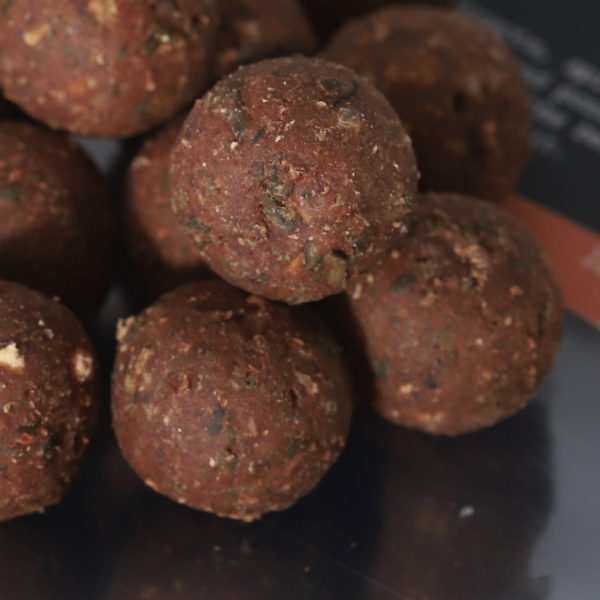
At certain times of year you can do that with colour. We all know how good white hookbaits can be for a quick bite. But once the weather warms up and the fish are actively hungry, wanting to eat regularly, bright hookbaits aren’t quite as good, to me. I’ll often tip my baits with a tiny bit of colour, simply to grab attention without making the hookbait look too obvious. A tiny bit of yellow on top is what I go for, but the hookbait itself is a drab colour, exactly the same as the feed. So when I’m boilie fishing with that dark red fishmeal, the hookbait will be the same, with that tiny bit of yellow on top.
Why boosted, not straight from the pot
With that said, my hookbaits are always boosted. I never use them straight out the tub anymore. They’re good enough to use straight from the bag or pot, you can do that, but I want that bait booming on the spot. When a fish comes in and starts feeding, I want it to pick that hookbait up as soon as possible. The quicker you get a pickup, the quicker you get a bite, and over a session, and particularly a season, you’ll get a lot more bites that way. So having a hookbait that stands out is very important.
Why wafters
When I’m boilie fishing, these are my hookbaits of choice: a wafter. I don’t really use straight bottom baits anymore. For many years now, rather than plugging bottom baits with cork, I use these wafters, which have cork dusting, so it saves all the aggro. They’re nice and hard, they don’t fall apart. There are lots of reasons to use an out-the-pot wafter like these.
The boosting process
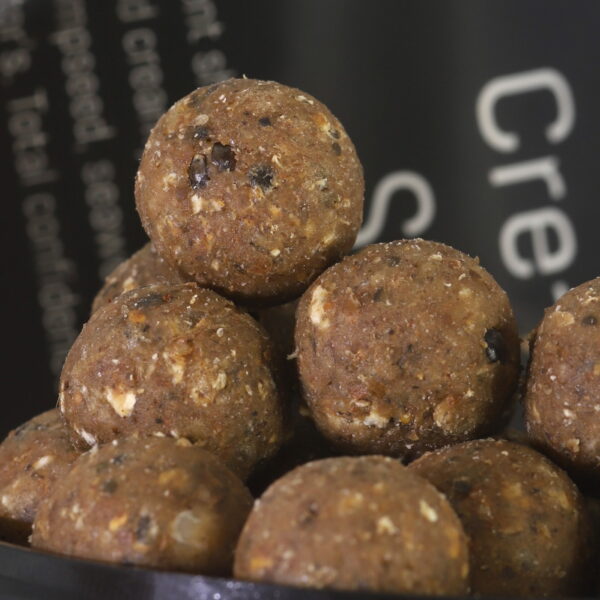
Before I use them, there’s a process I put in place. It takes about a week or so, sometimes longer, and the longer they cure the better. These hookbaits here are 18mm Atlantic Heat, but with a difference, massively boosted up. If I undo the lid, there you go: gooey, horrible, smelly, the sort of thing that would get you chucked out the house. When I’m preparing these in the garage it doesn’t smell nice, so if you’re going to do this, do it in the garden or garage, away from too many human beings, because you’re going to upset people.
Step one: Scent from Hell. The first thing I add is Scent from Hell liquid. I’ve used it for many years, well before it had a name, going back probably getting on for a decade. I remember the first time I smelled it. It’s now widely known as probably the worst-smelling liquid attractor available, but the fish absolutely love it. I take the wafters out and spray them up, a nice good coating, and repeat that four or five times, maybe once a day, out to the garage, spray them all up, let them soak it in. Really load them up, I’m not holding back.
Step two: Crustacean powder. On the fifth time, while the hookbaits are still wet, and that’s important, I add Crustacean powder. It’s a very fine powder that wafts up into the air as you open the pot. Because of the liquid, when you roll the hookbaits in it, it breaks down and goes into the bait. That’s very important, that’s what the curing process is all about, having that stuff on there that over time makes the hookbaits better. You can’t just do it in a day and use them, it’s not the same.
Step three: more liquid and C-Stim. After that, a little more Scent from Hell, and then in with the C-Stim. The C-Stim is lovely. I get a lot of funny looks, I know it’s barmy, but I can’t help licking my finger, dipping it in the pot and having a taste. It’s quite a beefy, tasty note, human-grade I’m sure, and I like it, and so do the carp. It’s a bit coarser than the Crustacean powder. Once that second layer is on, the hookbaits are quite dry, with a relatively even coating all around.
Step four: rest, then oil. Leave them for a couple of days to let that do its magic, and then on goes a little bit of hot fish oil. In the winter I’ll use the Super Hot oil, but in spring, summer and autumn I use the hot fish oil. As you can see, really gooey, really smelly, and the carp very much like them. It’s no wonder, you’re putting a lot of time, effort and really nice ingredients onto your hookbait.
The result: bites, faster
When I cast this onto a spot, I’m very confident it stands out above the rest. It doesn’t matter how much bait is on that spot, this is kicking up. The smell, the taste, everything about my hookbait is elevated compared to everything else, and in turn I get quicker bites.
Reading the birds
A lot of the time you can use the birds as an indicator. Unless you can go out in a boat and look at a spot, the birds are the best indicator of what’s actually happening out there. Say I put 50 baits onto a spot and get a bite in the night. In the morning the coots might turn up. If I’ve had my bite, my rods are back in position and I haven’t re-baited, and a coot comes out, dives and picks up straight away, there’s a very high chance there are only a handful of baits left on the spot. But if the coot is continuously diving, there’s obviously a lot of bait there. So that’s a good indicator that you’ve had a bite but your hookbait was one of the first to go, which is exactly what you want.
So in the summer, this is what I’m going to be using. Like I say, it takes about a week, but it’s well worth doing. The more effort you put into your fishing, the more you get back out of it.